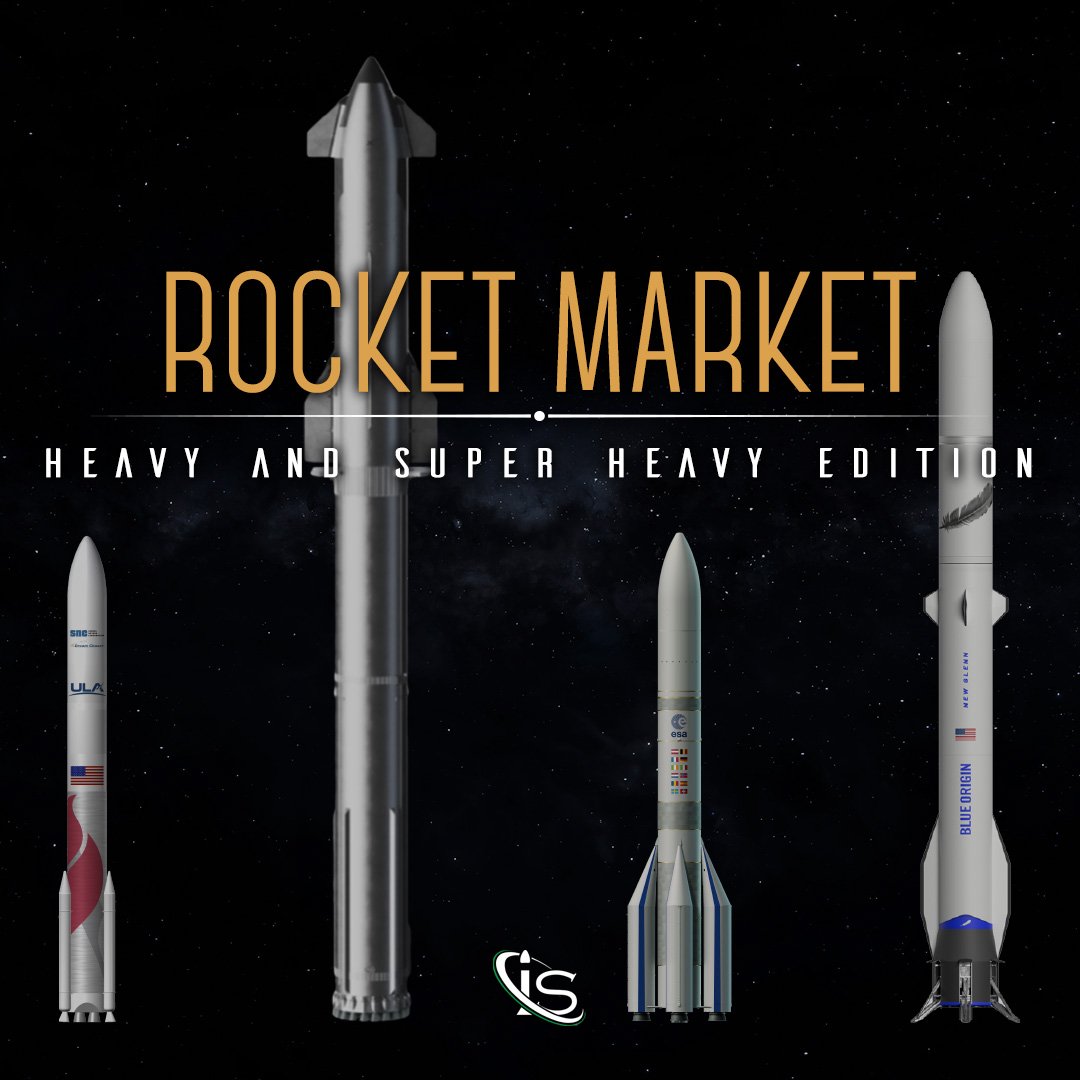
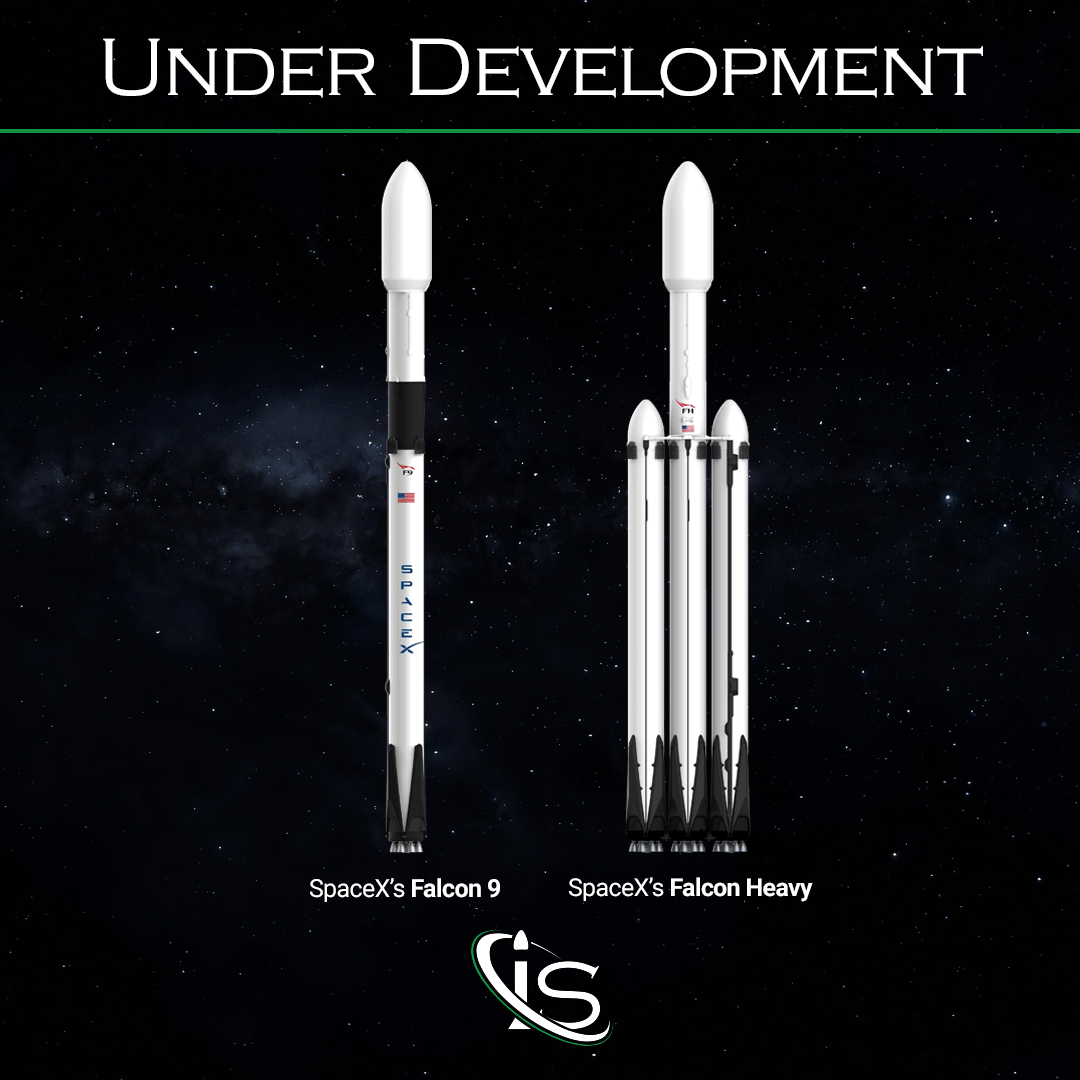
Impulso.Space is back with one of our most popular series: the ultimate rocket showdown! While we have explored many matchups over the years, this one is a first for us: Falcon 9 vs. New Glenn vs. Starship.
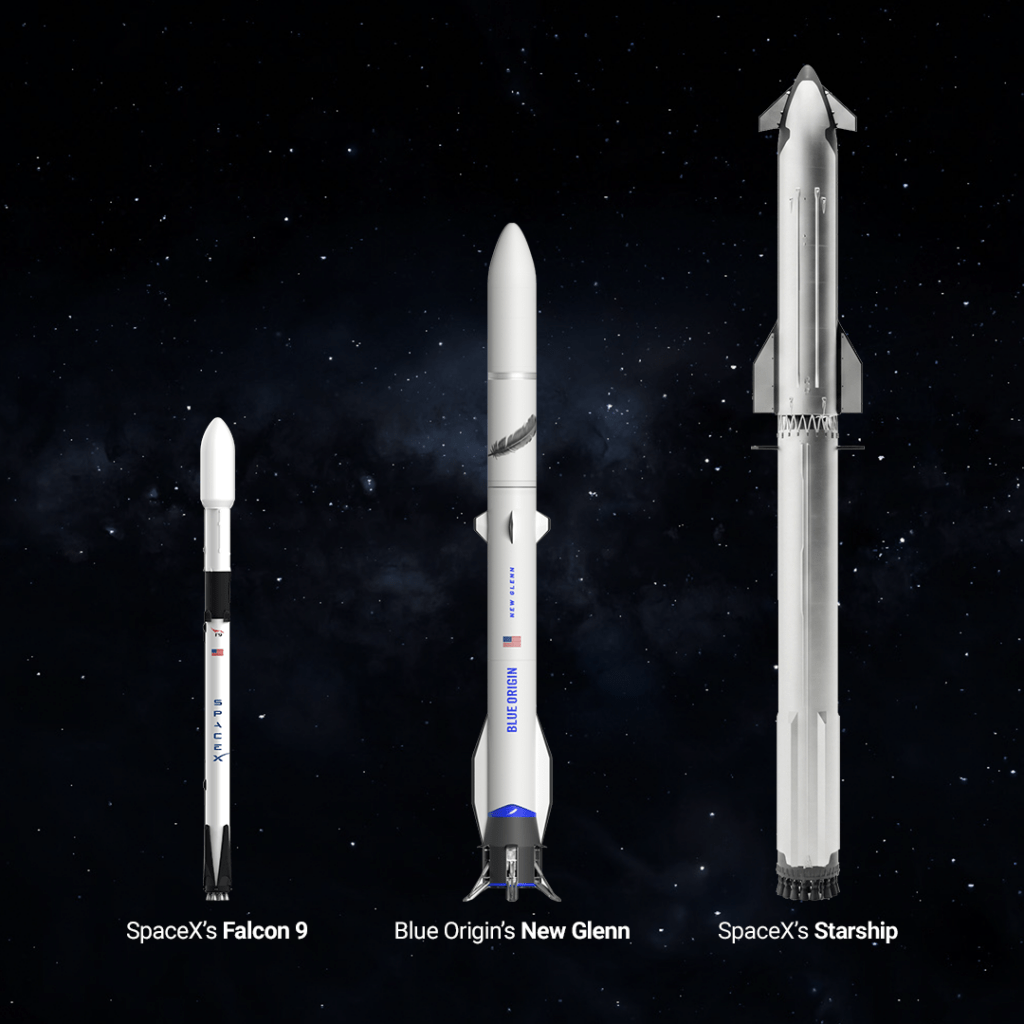
An immediate question arises: Why compare three rockets from such different Launch Vehicle classes?
New Glenn has rapidly become the newcomer to watch, “burning through the stages” of development. In just over a year and across only three launches, it has already achieved its first successful mission, recovered its first stage, and launched a flight-proven booster – and that is just scratching the surface. On the other end of the spectrum, we have Starship, the vehicle expected to revolutionize the industry and fundamentally change how we access the stars. Finally, there is the Falcon 9: in an industry where every metric is measured against SpaceX’s workhorse, no comparison is complete without the rocket we know best. And this is what it will be used for, as a comparison with respect to the two emerging rockets.
Let’s dive in!
Blue Origin’s New Glenn
New Glenn is the first orbital rocket developed by Blue Origin, the company founded by Jeff Bezos in 2000. Following the tradition of their suborbital program, New Shepard (named after the first American in space, Alan Shepard), New Glenn honors John Glenn, the first American to orbit the Earth in 1962.
Blue Origin designed New Glenn to drastically lower the cost of access to space. Central to this mission is a reusable first stage, designed for a lifespan of up to 25 flights. This reusability makes New Glenn a formidable competitor for civil, commercial, and national security missions.
Technical Configurations: 7×2 and 9×4
New Glenn is a massive, two-stage heavy-lift vehicle with two primary planned configurations:
- The 7×2 Variant: The current operational standard, featuring 7 BE-4 engines on the first stage and 2 re-ignitable BE-3U engines on the second stage. It is optimized for high-energy missions to LEO, MEO, and GEO.
- The 9×4 Variant: A future super-heavy evolution featuring 9 BE-4 engines and 4 BE-3Us, paired with an even larger fairing for massive constellations.
To put the power into perspective, a single BE-4 engine produces approximately 550,000 lbs (2,400 kN) of thrust—more than double the maximum thrust of a single SpaceX Merlin 1D engine.
Recovery and Reuse Heritage
The first stage’s reusability is supported by three key architectural features: two wing-like strakes for lift and cross-range control during reentry, four actuated fins for attitude adjustment, and a rugged landing gear system. These allow the booster to touch down on the sea-based landing platform, Jacklyn. While the first stage is already operational, Blue Origin is currently working on Project Jarvis to develop a reusable second stage, aiming for a fully reusable architecture.
With a massive 7-meter diameter fairing, New Glenn offers twice the payload volume of any other commercial rocket currently in service, with a capacity of 45 MT to LEO and 13 MT to GTO.
First Launches and Launch Cadence
Blue Origin has completed its initial flight test campaign, providing a “trial by fire” for the New Glenn architecture:
- NG-1 (January 16, 2025): Launched from LC-36 at Cape Canaveral, the maiden flight successfully reached Medium Earth Orbit (MEO) with the Blue Ring Pathfinder. While the orbital injection was a major success, the first stage was not recovered after a landing failure.
- NG-2 (November 13, 2025): This mission successfully sent NASA’s ESCAPADE spacecraft toward Mars. Most importantly, it marked the first successful vertical landing of the booster on the ship Jacklyn.
- NG-3 (April 19, 2026): A milestone in reusability, this mission featured the first flight of a re-flight booster (the one recovered from NG-2). While the booster was successfully recovered a second time, an anomaly in the second stage’s burn prevented the BlueBird 7 satellite from reaching its intended orbit, resulting in a partial mission failure.
Despite the recent upper-stage setback, Blue Origin’s ambitions for the future are massive. According to recent reports from Ars Technica, the company is targeting a dramatic increase in its launch frequency. CEO Dave Limp has indicated that Blue Origin is aiming for “well above a dozen” launches in 2026, with an ultimate goal of reaching a cadence of 100 launches per year as the 9×4 variant and Project Jarvis come online. This “launch-on-demand” target would position Blue Origin as the first true high-cadence alternative to SpaceX’s Falcon 9.
SpaceX’s Starship
SpaceX’s primary mission is to build a road to Mars. To establish a self-sustaining city, the requirement is the delivery of millions of tons of cargo and equipment. Elon Musk has estimated that to reach a critical mass of 100,000 tons on the Martian surface within a decade, Starship would need to fly approximately three times a day. This unprecedented launch cadence is only possible through full and rapid reusability. The Starship system consists of two stages: the Super Heavy booster, with a maximum thrust of approximately 72–80 MN (depending on the Raptor version), and the Starship spacecraft. Both are designed to be recovered, though their turnaround cycles differ: Super Heavy returns to the launch site in about six minutes, while the spacecraft must complete nearly a full orbit, taking roughly 90 minutes. Consequently, SpaceX’s operational model involves maintaining a much larger fleet of ships than boosters.
Overview of the Flight Test Campaign (2023–2026)
The development of Starship has been a test-fly-fail-fix journey. Here is the breakdown of the major milestones:
- IFT-1 (April 20, 2023): The first integrated launch. While it successfully cleared the pad, it did not achieve stage separation. The vehicle began to tumble and was destroyed by the Flight Termination System (FTS) four minutes into the flight.
- IFT-2 (November 2023): A major breakthrough. This was the first successful demonstration of Hot Staging—where the Ship ignites its engines while still attached to the Booster to push away. Both stages were lost shortly after, but the separation logic was proven.
- The Double Explosion Era: During IFT-3 and IFT-4, SpaceX introduced new Ship iterations. These missions saw the double explosions you mentioned: the booster would often break up during its final landing burn, and the ship would disintegrate during the extreme heat of reentry.
- IFT-5 (October 2024) – The Catch: This was the Mechazilla moment. For the first time, the Super Heavy booster successfully returned to the launch site and was caught in mid-air by the towers chopstick arms.
- Starlink & Orbital Milestones: By IFT-11 (October 2025), SpaceX successfully demonstrated the Starlink Pez-dispenser deployment system using mass simulators. This mission also culminated in the first soft touchdown of the Ship in the Indian Ocean, proving it could survive reentry and land precisely.
Rockets Comparison: Falcon 9 vs New Glenn vs Starship
In this last section, we will give the numbers behind these launch vehicles, in order to give a full comparison the two with reference to the numbers of Falcon 9.
General
This first table summarizes the size and the capacity of the three rockets that are defining the future of space access. It highlights how the industry is scaling up from the reliable Falcon 9 to the massive fairings and super-heavy capacities of New Glenn and Starship.
| Falcon 9 | New Glenn | Starship | |
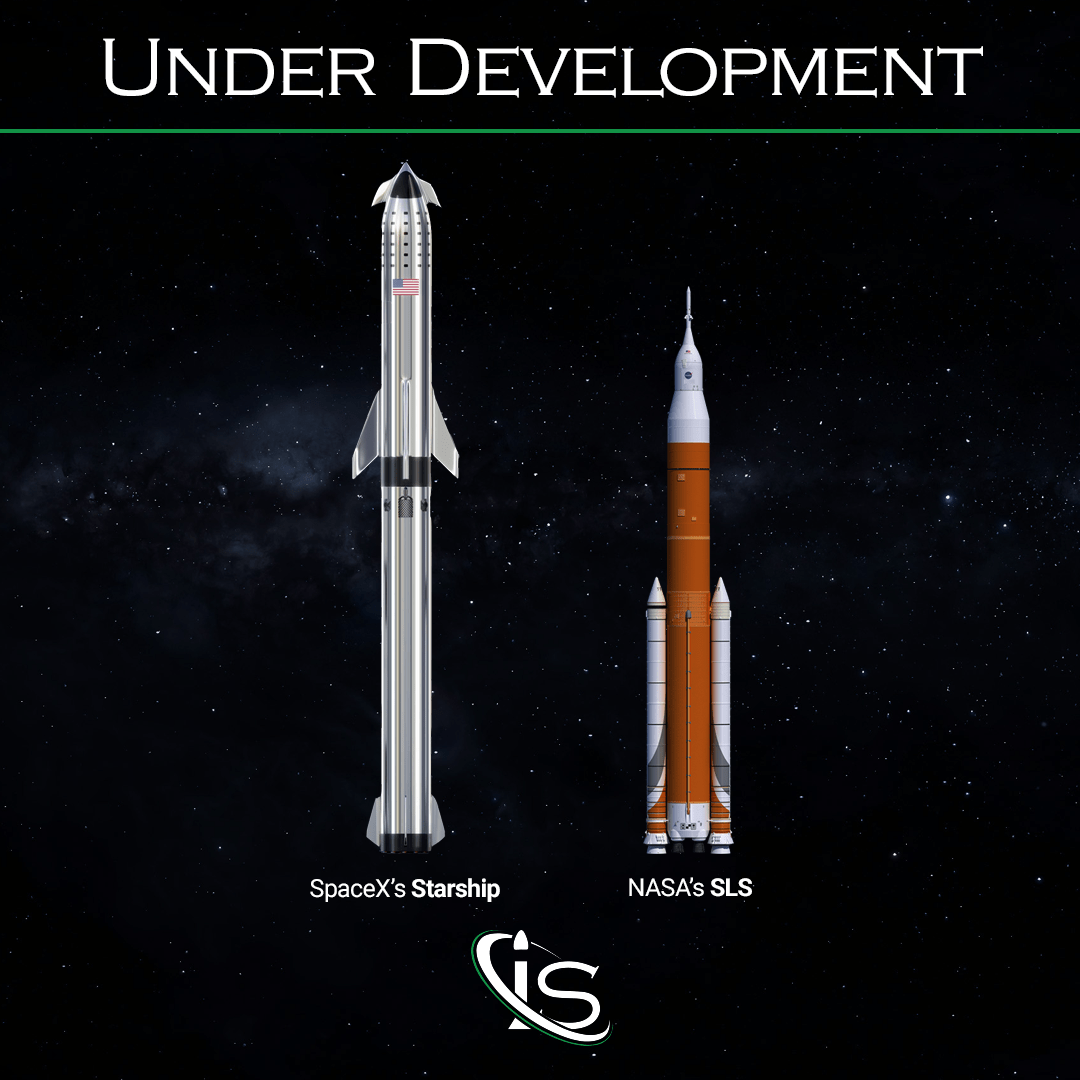
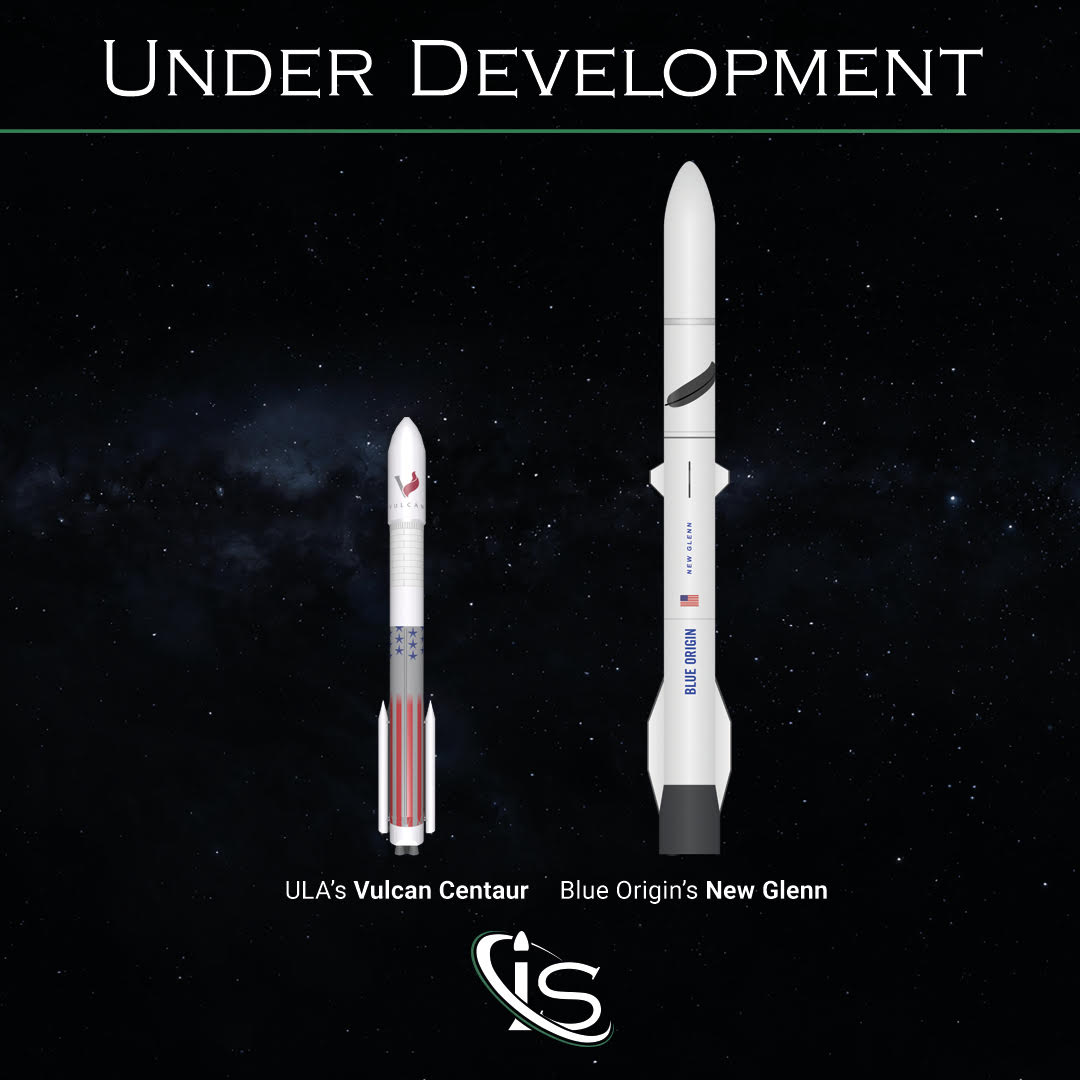
| Height | 70 m | 98 m | 123 m |
| Max Diameter | 3.7 m | 7 m | 9 m |
| Reusable | Partially | Yes | Yes |
| Capacity to LEO | Expendable: 22,800 kg Reusable: 17,500 kg | 7×2: 45,000 kg 9×4: > 70,000 kg | 100,000 kg |
| Capacity to GTO | Expendable: 8,300 kg Reusable: 5,500 kg | 9×4: >13,600 kg |
First Stage
After seeing the general comparison, it’s time to dive deeper into the First Stage of each rocket. This is the heart of the propulsion system and where the most significant technological shifts are happening, especially when we look at the engines and the fuel they burn. We must mention the incredible advance in power; the jump in Max Thrust from the Merlin to the BE-4 is a massive achievement, representing more than double the thrust! Additionally, the industry-wide shift from Kerosene to Methane (CH4) is a vital move toward a more ‘eco-friendly’ and sustainable solution for the future of spaceflight.
| Falcon 9 | New Glenn | Starship | |
| Height | 41.2 m | 57.5 m | 71 m |
| Engine Name | Merlin 1D+ | BE-4 | Raptor |
| Engine Number | 9 | 7 or 9 | 33 |
| Oxidizer/Fuel | LOX/RP-1 | LOX/CH4 | LOX/CH4 |
| Max Thrust | 7.6 MN | 7×2: 20 MN 9×4: 25.6 MN | 80.8 MN |
Second Stage
Finally, we reach the Second Stage of these vehicles. If the first stage is about the ‘brute force’ needed to leave the launch pad, the second stage is where the precision happens to reach the final orbit. In this section, we see even more diversity in engineering, particularly in the choice of propellants. While Falcon 9 sticks with the proven Kerosene, New Glenn moves to high-efficiency Liquid Hydrogen (LH2) and Starship sticks to CH4. It is clear that the industry is moving toward more complex, high-energy, and ‘eco-friendly’ fuels to tackle the most demanding missions in the solar system.
| Falcon 9 | New Glenn | Starship | |
| Height | 13.8 m | 23.4 m | 52 m |
| Engine Name | Merlin 1D Vacuum | BE-3U | Raptor & Raptor Vacuum |
| Engine Number | 1 | 2 or 4 | 3 & 3 |
| Oxidizer/Fuel | LOX/RP-1 | LOX/LH2 | LOX/CH4 |
| Max Thrust | 1 MN | 7×2: 1.8 MN 9×4: 3.6 MN | 14.7 MN |
Looking at these three giants side-by-side, it is clear that we are witnessing a historic ‘passing of the torch.’ While Falcon 9 remains the reliable workhorse that taught the world how to land a rocket, New Glenn and Starship are now pushing those boundaries to an entirely new scale. We are no longer just talking about reaching orbit; we are talking about building a permanent presence in space. From the record-breaking thrust of the Raptor 3 to the massive fairings 7-meter of Blue Origin’s newcomer, the industry is shifting toward a future of high cadence, ‘eco-friendly’ propellants, and massive payload volumes. As we wait for the maiden flight of Starship V3 and watch Blue Origin push for their ambitious 100-launch annual target, one thing is certain: the road to the stars has never been wider.
At Impulso.Space, we will be right here to witness which of these legends truly defines the next decade of discovery.